

Why does GLBA apply to colleges and universities?
For many colleges and universities, GLBA applies because they participate in federal student aid programs. The Department of Education has long considered institutions participating in Title IV programs subject to the GLBA requirements for protecting applicable customer information. The FTC Safeguards Rule requires covered financial institutions to maintain a written information security program with administrative, technical, and physical safeguards appropriate to their circumstances.
For higher education, the challenge is determining what is in scope, which institutional controls protect it, who owns those controls, what evidence demonstrates they are working, and which third parties also handle the information. Learn more about Higher Education Compliance Requirements →
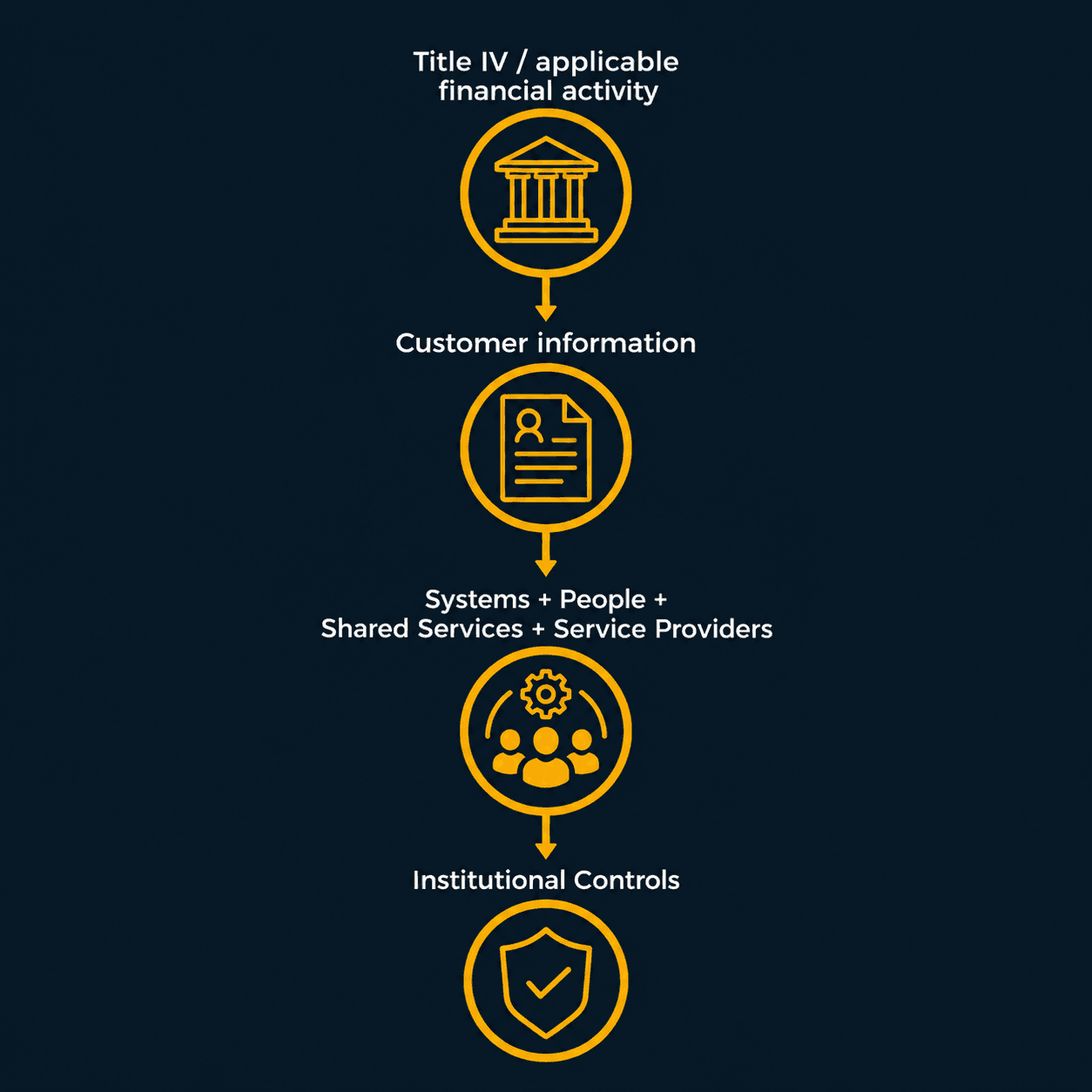
GLBA does not make the entire university one compliance scope
A university can participate in Title IV programs without every system, department, or activity operating in the same GLBA context. The institution needs to understand where applicable customer information is collected, stored, processed, transmitted, and accessed, and which systems, people, services, and third parties support those activities.
That can cross organizational boundaries. Financial aid may own the business process. Central IT may provide identity, networking, endpoint, logging, or infrastructure controls. Security may monitor the environment. Procurement may manage service-provider relationships. Legal, privacy, audit, and other teams may have additional responsibilities.
The regulatory obligation may begin with a particular activity. The controls supporting it can extend across the institution.
What does the GLBA Safeguards Rule require?
The Safeguards Rule requires a covered institution to develop, implement, and maintain a written information security program designed to protect customer information. Among the Rule's requirements are:
Designating a Qualified Individual to oversee the information security program
Performing and maintaining a written risk assessment
Implementing safeguards based on identified risks
Monitoring and testing the effectiveness of safeguards
Providing appropriate security training
Overseeing applicable service providers
Keeping the information security program current as circumstances change
Maintaining a written incident response plan
Reporting regularly, and at least annually, to the board or equivalent governing body
The Rule also contains specific technical requirements around areas such as access control, encryption, multifactor authentication, system and data inventory, secure development, change management, logging, and monitoring, subject to the Rule's provisions and applicable exceptions.
Authoritative source: FTC Safeguards Rule guidance →
The harder question is: who actually owns the safeguards?
A requirement can be straightforward on paper and distributed in practice. Consider access control. Financial aid may depend on an enterprise identity platform operated by central IT. Security may monitor authentication activity. HR processes may affect provisioning and termination. A cloud provider may host the application containing customer information. The institution therefore needs more than a statement that access controls exist. It needs to know:
Who operates the control?
Which environment relies on it?
Which systems inherit it?
What evidence demonstrates that it is operating?
Who reviews that evidence?
What happens when the control changes or fails?
This is where GLBA becomes part of institutional governance rather than a financial-aid-office checklist.
GLBA compliance needs evidence, not just policies
A written information security program is necessary, but institutions also need to show that the safeguards described in the program are governed and operating. That can mean maintaining evidence around areas such as:
Risk assessments
Control implementation and testing
Access-control reviews
Security training
Vulnerability and security testing
Incident-response activities
Service-provider oversight
Program changes
Governance reporting
The exact evidence depends on the requirement and the institution's environment. The important operational question is whether the institution can reconstruct the governance record: What was required? What control addressed it? Who owned it? What evidence supported it? What changed? What happened next?
GLBA compliance is part of the Title IV audit environment
For institutions participating in Title IV programs, GLBA should not be treated only as an internal cybersecurity concern. Federal Student Aid guidance ties GLBA cybersecurity compliance to institutions' administrative capability, and Title IV institutions operate within an annual compliance-audit environment. Current FSA guidance also states that institutions must demonstrate compliance with applicable GLBA cybersecurity requirements.
That changes the practical question from “Do we have security controls?” to “Can we demonstrate how the applicable safeguards are governed and operating?” That requires current ownership, evidence, risk decisions, service-provider oversight, and history, not a scramble to reconstruct the program when evidence is requested.
Service-provider oversight is part of GLBA
The Safeguards Rule does not stop at the institution's boundary. Covered institutions must take reasonable steps to select and retain service providers capable of maintaining appropriate safeguards, require relevant safeguards by contract, and periodically assess service providers based on their risk and the continued adequacy of their safeguards. For a university, applicable providers can sit across a broad technology and operational environment.
The governance problem is maintaining the relationship between:
Provider → Service → Customer Information → Control → Evidence → Risk → Owner
A questionnaire by itself does not establish that relationship.
A GLBA control may already exist elsewhere in the university
GLBA does not operate in isolation from the rest of the institution's security program. Access control, incident response, security awareness, vulnerability management, logging, encryption, risk management, and vendor oversight may already support other institutional requirements.
That creates an important distinction; the control can be shared, but the obligation remains distinct. If an existing institutional control satisfies an applicable GLBA requirement, the university should be able to identify that relationship and reuse appropriate implementation and evidence rather than recreating the control inside a separate GLBA workstream.
If GLBA requires something additional, that difference should be visible too. That is the delta.
Related: Higher Education Compliance Requirements →
Manage GLBA through the controls the university actually operates
Cyturus uses the Living Control Set (LCS) as the governed record of the controls an institution actually relies on. GLBA can be evaluated against that control environment rather than managed as an isolated set of requirements. That allows the institution to connect applicable GLBA requirements to:
Existing institutional controls
Control owners
Evidence
Organizational scope
Risks and deficiencies
Service-provider relationships
Remediation and actions
Governance history
Where the institution already satisfies a requirement, that relationship becomes visible. Where GLBA adds a requirement or exposes a deficiency, the gap remains visible too. Explore Higher Education & Research →
When GLBA changes the requirement, find the delta first
Before creating another compliance workstream, start with the university's existing control environment. Ask:
Which GLBA requirements apply?
Which environments and customer information are in scope?
Which existing controls already support those requirements?
Which evidence can legitimately be reused?
Which controls are inherited from shared institutional services?
Which service providers are in scope?
What is actually missing?
The result is a more useful starting point than another blank assessment.
See what GLBA actually adds to your control environment.
Compare GLBA requirements with the controls your institution already operates. Identify existing coverage, reusable evidence, and the gaps that require attention.
Get a Framework Impact Analysis →
Frequently Asked Questions
Does GLBA apply to colleges and universities?
It can. The Department of Education requires institutions participating in Title IV federal student-aid programs to protect applicable student financial information under GLBA cybersecurity requirements. Institutions should determine the information, systems, services, and third parties that fall within their applicable scope.
What does the GLBA Safeguards Rule require?
Covered institutions must maintain a written information security program with administrative, technical, and physical safeguards. Requirements include risk assessment, designated program oversight, safeguards, testing and monitoring, staff training, service-provider oversight, incident response, program maintenance, and governance reporting.
Is GLBA only the financial aid office's responsibility?
No. Financial aid activities may create the obligation, but central IT, information security, procurement, privacy, legal, vendors, and other teams can operate the controls that support those activities. Responsibility therefore often crosses organizational boundaries.
What evidence is needed for GLBA compliance?
Evidence depends on the institution and applicable requirement. Still, it may include risk assessments, control and testing records, access reviews, training records, incident-response documentation, service-provider oversight, program updates, and governance reporting. Institutions should align evidence with the specific Safeguards Rule requirement it is intended to demonstrate.
Does GLBA require universities to assess service providers?
For applicable service providers, the Safeguards Rule requires covered institutions to take reasonable steps when selecting providers, contractually require appropriate safeguards, and periodically assess them based on risk and the continued adequacy of their safeguards.
Is GLBA the same as NIST SP 800-171?
No. They are separate requirements with different purposes and applicability. A university may operate controls that support both, but shared controls do not make the requirements equivalent.
Can existing university controls be reused for GLBA?
Yes, when an existing control appropriately satisfies the applicable GLBA requirement and scope. The institution should preserve the relationship between the requirement, implementation, evidence, ownership, and scope rather than assuming that similar control language automatically establishes compliance.


